
- This event has passed.
TerraDT Workshop: Urban Impact Models for Climate Adaptation
February 23 @ 2:00 pm - 6:00 pm CET
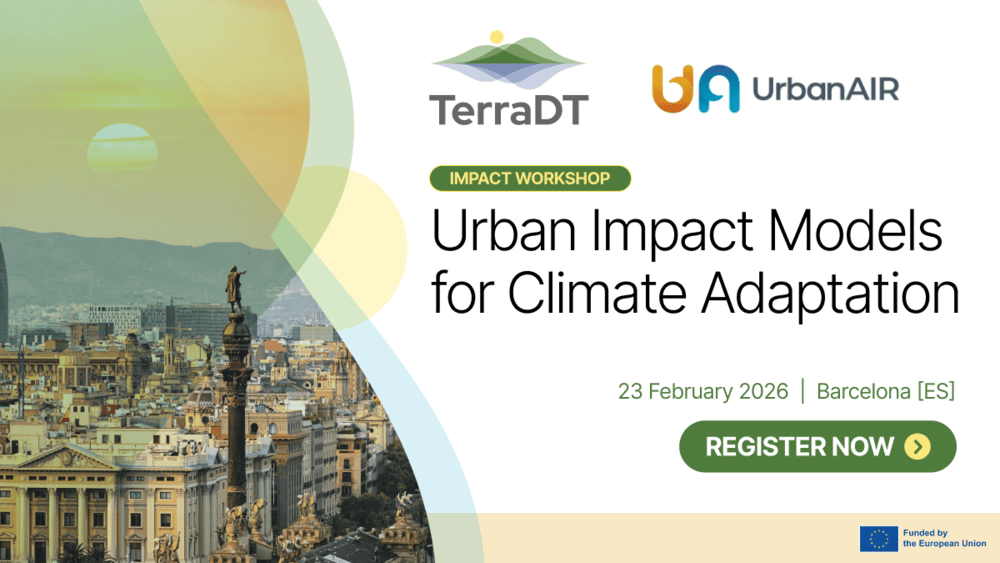
TerraDT is organising an Urban Impact Model Workshop in Barcelona this February, bringing together public and private stakeholders working at the intersection of cities, climate adaptation and decision-making.
The workshop will showcase how TerraDT’s urban impact models translate high-resolution climate and environmental data into actionable insights for cities. Participants will explore use cases relevant to urban planning and climate adaptation policies with a focus on heat stress, air quality, extreme events, and their impacts on people, infrastructure, and assets. The event will also host experts from our sister project UrbanAIR, the digital twin for urban climate action.
Who should attend?
Designed for city and urban planners, local and national authorities, weather and health services and environmental agencies but also for real estate investors and insurance companies, the event will offer a space to engage directly with scientists and model developers. Through targeted presentations and interactive discussions, attendees will gain a clearer understanding of how digital twins can support evidence-based policies, resilient urban development, and informed strategies for more resilient cities.
The workshop also aims to gather feedback from practitioners, ensuring that TerraDT’s urban impact models respond to real-world needs and decision contexts. Participants will leave with practical insights into how advanced climate modelling can be integrated into planning, risk management, and long-term urban strategies.
For the Destination Earth community, the TerraDT Urban Impact Model Workshop is a concrete opportunity to see how DestinE-aligned, high-resolution climate data can be translated into decision-ready intelligence at city scale. The workshop focuses on urban impact models that connect climate hazards—such as heat stress, air quality and extreme events—with tangible impacts on people, infrastructure and assets, directly supporting DestinE’s ambition to move from system-level simulations to actionable use cases.
By bringing together scientists, model developers and end-users, TerraDT offers a practical space to discuss integration, usability and feedback loops that are essential for strengthening DestinE’s downstream applications in climate adaptation and urban resilience.