HectoRenew
 Austria
HectoRenew
January 1, 2025
December 31, 2026
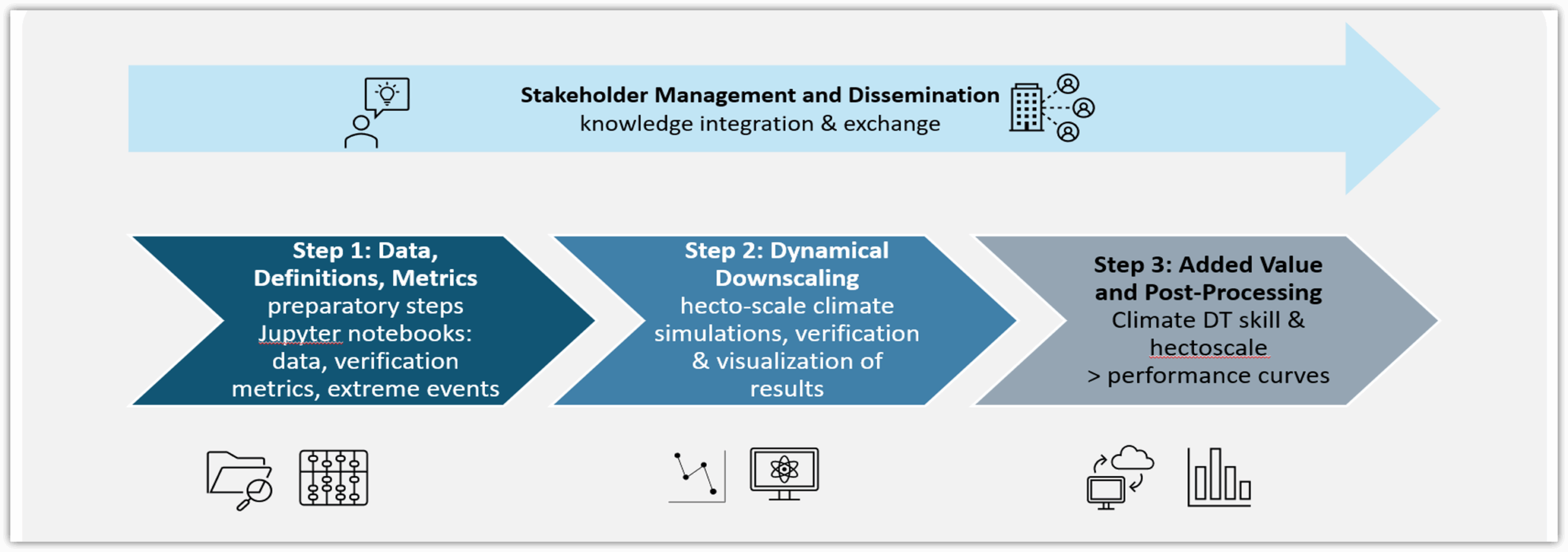
Within the project HectoRenew, funded by the FFG, we plan to investigate the added value of hectometric (200 – 800 m) downscaled DT Climate data for applications in the renewable energy sector, building upon the two high-priority digital twins: Extremes & Climate DT.
The DT on Weather-Induced Extremes focuses on developing an extreme weather on-demand DT, which is provided by ECMWFEuropean Centre for Medium-Range Weather Forecasts More on the global scale and by the ACCORD consortium (21 European institution) on the sub-km scale for certain regions. The DT Climate for Climate ApplicationAn action, information product, or service (including consul More produces multi-decadal projections (past, future) at km scale (approx. 5 km) to understand climate change and support adaptation strategies and policymakers across the impact sectors most affected.
While both DTs are outstanding in their respective fields, combining these two ideas, as envisioned within HectoRenew, would leverage knowledge even more as DT Climate provides long-term simulations, while DT Extremes includes aspects such as pattern detection of high impact events. Additionally, the DT Climate covers aspects of wind energy, yet on an overall perspective not specifically focusing on extreme events. Thus, coupling these two approaches provides new possibilities to meet the information demand of renewable energy providers.
The transformation to renewable energy is needed quickly and even though there are many initiatives that drive this transition, there are still uncertainties with respect to secured power supply solely based on renewables under current and future climate conditions. These uncertainties also stem from the fact that renewables, especially PV and wind, are susceptible towards changes on the short time scale and very high resolution. Since Climate DT is provided on 5 km, it is feasible to directly downscale down to hecto-scale using climate models to assess future local climate conditions on 200 to 800 m spatial resolution, better representing local characteristics.
The overall aim of HectoRenew is to analyse the usability of Climate DT output for the renewable energy sector, either directly or as input for setting up dynamical climate simulations at the hecto-scale.