DestinE Pilot Service for supporting European Farmers’ Decisions in Perennial Agriculture – first results
As climate change reshapes the landscape of European agriculture, the need for precision-guided adaptation has never been more critical. The “Pilot ServiceRegular provision of technological capabilities, resources, More for supporting European Farmers’ Decisions in Perennial Agriculture”, also called SEEDS and developed within the ambitious Destination Earth (DestinE) initiative of the European Commission, has just completed its first 8 months of development. The mission of this Pilot ServiceRegular provision of technological capabilities, resources, More is to bridge the gap between complex climate data and the practical needs of perennial agriculture, specifically focusing on the future of vineyards and apple orchards. Here is a look at what has been achieved during this foundational year and why the Pilot ServiceRegular provision of technological capabilities, resources, More aims to become a game-changer for farmers.
Co-design: building for farmers, with farmers
The Pilot ServiceRegular provision of technological capabilities, resources, More is build on the foundation that a climate service is only as good as its usability in the field. That is why it has prioritised a human-centered design approach since its kickoff in May 2025. This approach has been implemented through the following activities:
- Kick-off workshops: the journey started with selected focus groups in Trento, Italy, bringing together farmers and decision-makers to explore climate challenges and gather the requirements that guide our project.
- User-centric insights: through these sessions and a survey involving over 130 stakeholders, the implementing team identified that climate risks are best understood in terms of their impact on crop quality, long-term strategy, and economic sustainability.
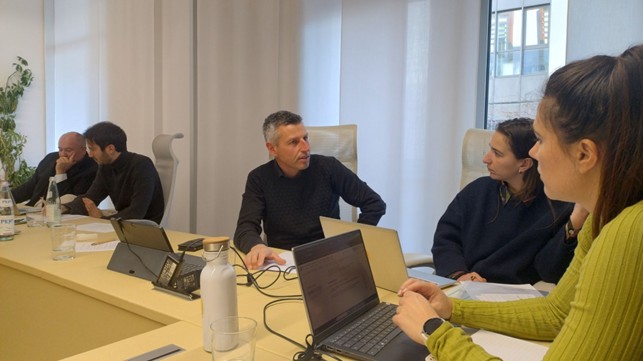
- Co-development action: in December, the team held a follow-up workshop to test the prototype’s usability and the methodology to assess the adaptation strategies in agriculture. This hands-on session provided valuable feedback to ensure our tools are practical and user-friendly for real-world agricultural needs.
Innovation at the DestinE Hackathon
Technical progress was accelerated during the Digital Twin Co-design Hackathon held on 5 –7 November 2025 in Bonn. This resulted in the following key outcomes:
- Collaborative design: developers and partners collaborated to test applications using the Climate Change Adaptation Digital Twin (Climate DT) and Weather-Induced Extremes Digital Twin (Extremes DT).
- Expert integration: the Finnish Meteorological Institute (FMI) contributed expertise in data modeling and workflows, ensuring that the high-level capabilities of DestinE are linked directly to agricultural needs.
The technical backbone: translating data into decisions
The technical core of the Pilot ServiceRegular provision of technological capabilities, resources, More lies in its ability to translate high-resolution Climate DT simulations into “bioclimatic indicators”. This includes:
- Multi-hazard analysis: a framework to assess four primary hazards: heat stress, drought, frost, and excess rain.
- Phenological alignment: a standout feature of the Pilot ServiceRegular provision of technological capabilities, resources, More is the linkage between these hazards and specific crop phenological phases. This enables producers to assess not only the occurrence of heat, drought or frost, but whether these conditions coincide with critical phases such as flowering or ripening.
- Rigorous validation: to ensure reliability, the team compared Climate DT outputs against independent datasets like ERA5 reanalysis1 and E-OBS station data2 . This ensures the information provided to farmers is grounded in scientific accuracy.
Seamless integration and accessibility
Technically, the Pilot ServiceRegular provision of technological capabilities, resources, More is designed for performance, including:
- A two-stage architecture: to avoid delays caused by system loads, it adopted an architecture where indicators are pre-computed while still allowing for user-defined thresholds. This ensures the service to remain fast and reliable for the end user.
- DestinE PlatformSelf-standing DestinE system component, interfacing with the More deployment: onboarding on the DestinE Platform paves the way for full integration and public access.
From risks to remedies: the adaptation catalogue
The Pilot ServiceRegular provision of technological capabilities, resources, More has established a structured catalogue of adaptation measures, which are linked to specific climate hazards. These measures are evaluated through an ESG (Environmental, Social-Economic, and Governance) framework, allowing users to compare different strategies for long-term resilience.
What’s next for 2026?
The result of the Service’s first eight months is a validated and user-approved framework. While the current focus is on grapevines, it will expand to include apple production systems moving forward. The implementation team is also testing the “transferability” of its tools by engaging with agricultural stakeholders in Norway, ensuring the platform works across different European climates.
[1] ERA5 Reanalysis: The fifth generation of atmospheric reanalysis from the ECMWFEuropean Centre for Medium-Range Weather Forecasts More, combining historical observations with modern models to provide a consistent map of the past climate.
[2] E-OBS Station Data: A high-resolution European dataset based on direct observations from ground-based weather stations used to verify model accuracy at the local level.