Key highlights from the latest DestinE User eXchange
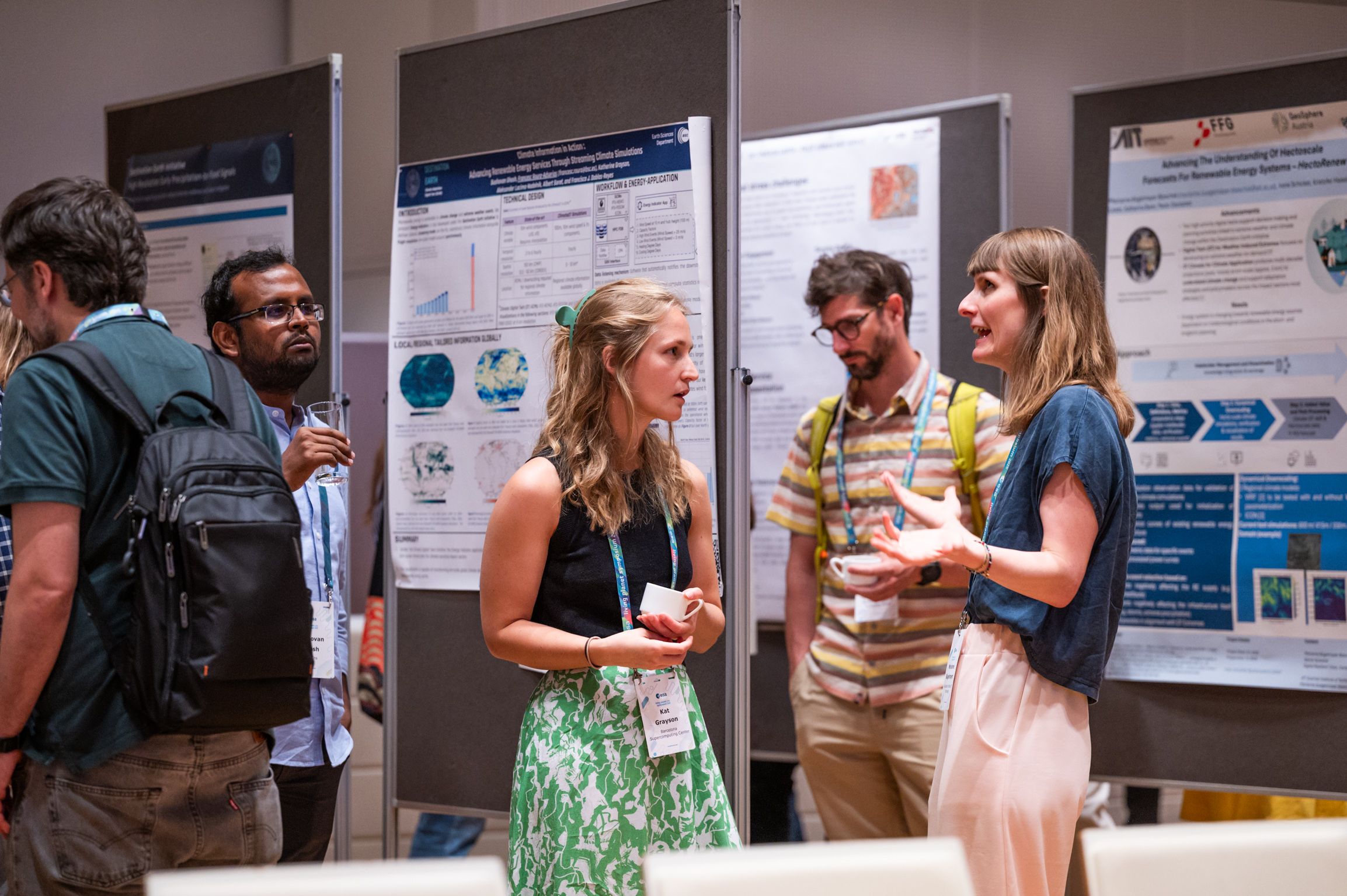
Last month, ESAEuropean Space Agency hosted the 4th DestinE User eXchange in Vienna, Austria. The meeting took place in parallel with ESA’s Living Planet Symposium (LPS), one of the world’s largest Earth observation conferences.
Around 350 people attended the User eXchange, in person or online. During the event, speakers talked about the current status of DestinE and outlined the next steps for the initiative. If you were unable to attend, here are some key highlights:
1- Expect new services on DestinE’s Platform
The DestinE Platform opened in October last year and had, up until June, made 23 services available to more than 3,000 users. As the point of entry to DestinE, the platform provides users with data and applications from the Digital Twins and Data Lake, services and tools.
At the User eXchange, Kathrin Hintze from ESA announced that the DestinE PlatformSelf-standing DestinE system component, interfacing with the More will have new services soon: five core ones coming this summer and 12 additional advanced ones later this year. Core services handle essential tasks like onboarding users, accessing data and supporting other functions. Advanced services build on top of these. They use the core tools to process data, visualise results and deliver solutions tailored to specific themes or domains.
One of these new advanced services will be HARVICe (Harvest in Control). It will deliver automated, satellite-based crop monitoring data to users. These data can support the agricultural sector in yield forecasting and sustainable farming practices, among other applications.
Another service, the Desert Locust Monitoring ServiceRegular provision of technological capabilities, resources, More, will help users identify regions at risk of desert locust outbreaks. Locusts are insects related to grasshoppers and are usually solitary, but under certain conditions they form swarms that devastate agricultural crops. With this new DestinE service, users will be able to combine AI techniques and multi-source climate data to forecast swarm formation up to two weeks in advance. This could help farmers and local producers better prepare. You can learn more about the upcoming services here.

ESAEuropean Space Agency also talked about the user-driven roadmap on the DestinE PlatformSelf-standing DestinE system component, interfacing with the More. This is a place where users can propose new features and help shape priorities for future developments.
2- Developments in the Digital Twins and the Digital Twin Engine
DestinE’s first two high-priority Digital Twins are the Weather-Induced Extremes Digital Twin and the Climate Change Adaptation Digital Twin. ECMWFEuropean Centre for Medium-Range Weather Forecasts More and its partners are working on both and, at the User eXchange, highlighted multiple features that can benefit all users.
Irina Sandu, Director for DestinE at ECMWF, highlighted some of the key advances made by the wide partnership, involving more than a hundred institutions from over 25 countries in Europe. They all contribute to the implementation of the Climate Change Adaptation Digital Twin (Climate DT), the Weather-Induced Extremes Digital Twin (Extremes DT) and the Digital Twin Engine, in close collaboration with ECMWFEuropean Centre for Medium-Range Weather Forecasts More.
Since the beginning of the initiative, ECMWFEuropean Centre for Medium-Range Weather Forecasts More and its partners have built the software and modelling infrastructure for a bespoke simulation capability able to address ‘what if’ questions, such as “What specific adaptation measures can limit the consequences of recent and future events?”
The Climate Change Adaptation Digital Twin delivers global high-quality climate information at scales that matter to society. Irina explained that the team is working on a structured production cycle with separate development, piloting, and operational workflows. This will allow the new model capabilities to be tested while moving towards an operational stream that will deliver reliable, traceable, and quality-controlled simulations.
The Extremes DT is producing daily global simulations of extreme weather events at a 4.4 km resolution, up to four days in advance. It’s also providing regional simulations at a much finer resolution, between 500 and 700 metres, two days ahead of high-impact extreme weather events. These are piloted when extreme events occur over Europe.
Over the past few months, ECMWFEuropean Centre for Medium-Range Weather Forecasts More and the consortium led by Météo France – which is responsible for building the regional component of this digital twin – have been working to examine the added value of the Extreme DT data together with the national meteorological services.
Irina Sandu highlighted that “the Digital Twins are complementing existing capabilities at the national and European levels. They aim to support national institutions mandated to protect lives and properties, particularly national meteorological and hydrological services, by providing an additional tool with enhanced flexibility of simulations and outputs.”
3- Explore the new Edge services
A key development since the 3rd User eXchange is that DestinE has opened its Edge services to users, inviting them to actively contribute to the initiative. These are services that enable exploration or development of applications on the edge of the Digital Twin model outputs, enhancing performance, responsiveness, and accessibility to DestinE data.
Researchers and developers can tap into over 120 petabytes of storage, run computations on more than 20,000 CPU cores and 60 GPUs, and build solutions directly within a distributed infrastructure that spans across Europe. These resources sit near major high performance computing centres, namely LUMIOne of the EuroHPC pre-exascale supercomputers, hosted and o More, MareNostrum and LeonardoOne of the EuroHPC pre-exascale supercomputers, hosted and o More which then allow users to process data, run models, and test scenarios close to where the Digital Twins operate.
Other locations near Big Data stores are also at hands to users through the Edge services. This setup enables users to create new applications, explore “what-if” simulations, and foster the development of small to medium-scale AI models. Follow the online documentation to submit your project.
During LPS, EUMETSAT hosted its first training session on these services to help users gain hands-on experience. If you are keen on trying them yourself, you can find tutorials and webinars that will help you here.
4- Meet the new Learning Hub
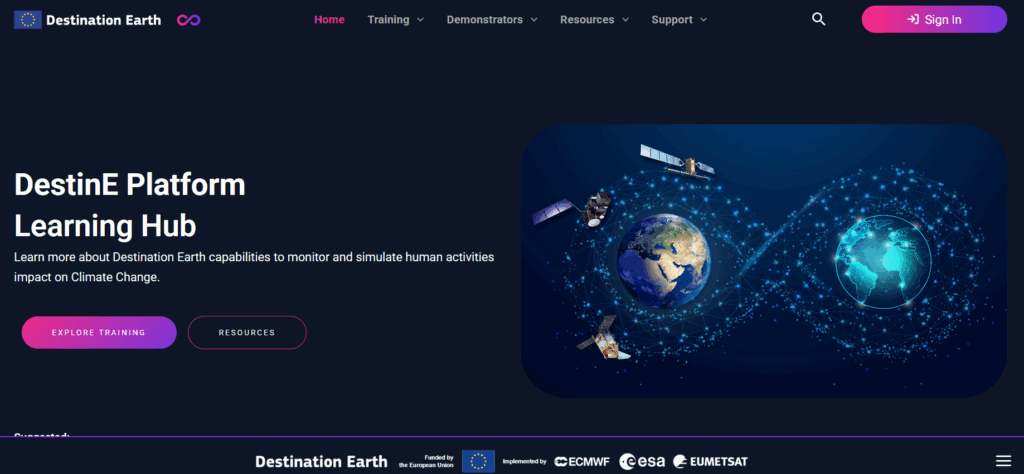
At the User eXchange, developers of the DestinE PlatformSelf-standing DestinE system component, interfacing with the More introduced a new feature: the Learning Hub, designed to support all users, from expert data analysts to entry-level researchers.
Accessible to everyone, including those not yet registered on the platform, the hub provides structured and curated access to multiple learning resources. Within the hub, you can explore a collection of video tutorials that guide you through how to use each service. You will also find demos, presentations and useful links.
5- Shaping DestinE’s future through user feedback
Over the course of the week at LPS, DestinE teams actively engaged with users on site. They conducted 73 demonstrations of DestinE tools at a dedicated booth, reaching around 900 participants. These brief presentations introduced the DestinE PlatformSelf-standing DestinE system component, interfacing with the More, onboarding workflows, and a growing range of services.
Participants were also able to book one-to-one sessions with DestinE staff to gain a deeper understanding of the initiative and its capabilities. A total of 44 individual sessions were held, where users were able to get personalised support and ask specific questions about their projects.
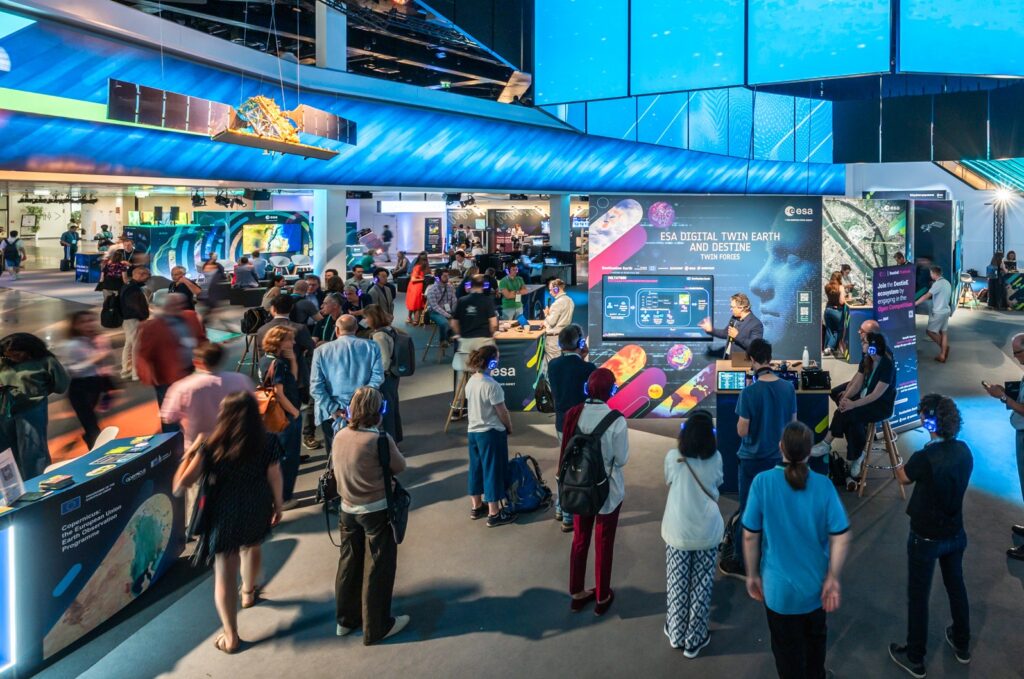
Credit: ESAEuropean Space Agency/J.Mai
In addition, the User eXchange team held several conversations with users to gather their feedback on the initiative overall and discuss potential improvements.
One recurring point raised by the audience concerned user engagement. Attendees raised the point that the DestinE PlatformSelf-standing DestinE system component, interfacing with the More must appeal to users and also support them, regardless of their level of expertise. All three entities – ECMWFEuropean Centre for Medium-Range Weather Forecasts More, ESAEuropean Space Agency and EUMETSATEuropean Organisation for the Exploitation of Meteorological – agreed that upcoming actions must focus on how users engage with DestinE. As DestinE offers capabilities beyond those offered by other Earth observation initiatives, it is important to ensure users are fully aware of what it provides.
“These data and services are only valuable if they are used,” said Michael Schick from EUMETSATEuropean Organisation for the Exploitation of Meteorological. “Long-term availability, maintenance and evolution have been secured for the entire initiative. Next, it’s important that we make this a product that users really want to use.”
“DestinE is not just about showcasing data or models; it’s about enabling action. We’re building a system that empowers users to explore, understand and shape the future using Europe’s best Earth science and computing technology,”added Claudia Vitolo from ESAEuropean Space Agency.
Over the next few weeks, we will publish a detailed post-event report on DestinE’s 4th User eXchange, as well as a collection of event recordings, videos and slides. Follow us on LinkedIn to stay up to date!