Meet the team: ESA
Destination Earth (DestinE) is built around three core components: the Digital Twins, the Data Lake and the Platform. Drawing on its expertise in leading complex, collaborative programmes, ESAEuropean Space Agency is responsible for delivering the DestinE Platform.
ESA’s team works with dozens of partners across Europe to build, maintain and innovate the DestinE PlatformSelf-standing DestinE system component, interfacing with the More, which acts as the main point of entry for DestinE data and services. Meet some of the people who are making it all happen:
Building and testing the DestinE PlatformSelf-standing DestinE system component, interfacing with the More
Inés Sanz Morère, DestinE’s Earth Observation Data Processing Engineer, is the technical officer who oversees the contract that develops and operates the platform. She meets with the companies implementing and operating the platform services, addresses issues, and ensures that services remain reliable for users. She also coordinates new features requested by the European Commission and works to onboard services that match DestinE’s evolving goals.
Beyond day-to-day operations, Sanz Morère focuses on keeping the platform useful and dynamic. She works to ensure high-resolution datasets – like those produced by ECMWF’s Digital Twins – translate into clear information for end users, including policymakers.
“We’re adding more and more services to the platform, and we can’t let them stay frozen in time,” she adds. “The community will keep changing, so the platform has to keep evolving too, it has to stay useful.”
Inés Sanz Morère works from her office in ESA’s premises in Frascati, Italy
With an eye to DestinE’s future, Luca Girardo works on introducing advanced infrastructure services that will support DestinE’s future products. With a background in computer science, he is the DestinE and Copernicus Advanced Infrastructure ServiceRegular provision of technological capabilities, resources, More Manager at ESAEuropean Space Agency.
Although his work focuses on infrastructure services, he does not build systems himself. Instead, he scours the European space industry landscape for systems that already exist but could be integrated as services into the platform to serve users directly. “The platform is the entry point for all DestinE services,” he explains. “I work towards finding a way to provide access to high performance computing (HPC) and quantum computing as a service within the platform, for example.”
‘HPC as a service’ would allow users to run models, test algorithms or perform large simulations using DestinE data without investing millions in their own infrastructure. These services would sit inside DestinE, and users could activate them when needed. Much of Girardo’s daily work involves guiding companies through the design, development and integration of these services.
Franka Kunz and Luca Girardo at ESA’s Living Planet Symposium in June 2025
But having cutting-edge services is not enough: someone needs to test them to ensure they work as intended – and this is where Sébastien Tétaud’s role begins. Having worked as an AI engineer and data engineer in institutions and startups around the world, he is now DestinE’s AI Systems Engineer. Tétaud develops early AI prototypes and explores how future AI-driven services could fit into the DestinE PlatformSelf-standing DestinE system component, interfacing with the More. He develops proof-of-concept tools and minimum viable products that help identify what the platform should offer next.
Another crucial part of Tétaud’s work involves testing – most new services go through his hands. He evaluates user experience, compares performance through benchmarks and looks for anything that might confuse or slow down users. When he finds an issue, he files a ticket and follows the process until it is fixed.
For him, a smooth interface is essential: users should move between services without friction. “All the feedback I have given has been taken into account,” he says. “The issues were corrected, and users can now enjoy something that works. In that sense, I’m helping reduce risks for the platform, and I’m very happy about that.”
Bringing the platform to users
Once services function smoothly, the next challenge is ensuring the platform reaches its community. Franka Kunz started working for DestinE as a DestinE Earth Science Model Engineer. However, she has since transitioned to a user engagement role. Thanks to her background in geography and geoinformatics, she navigates the complex DestinE user community and engages with its members on multiple levels.
She helps manage the DestinE website, coordinates with communication teams, and represents ESAEuropean Space Agency at numerous events where she presents the initiative, speaks with participants and learns about what users need.
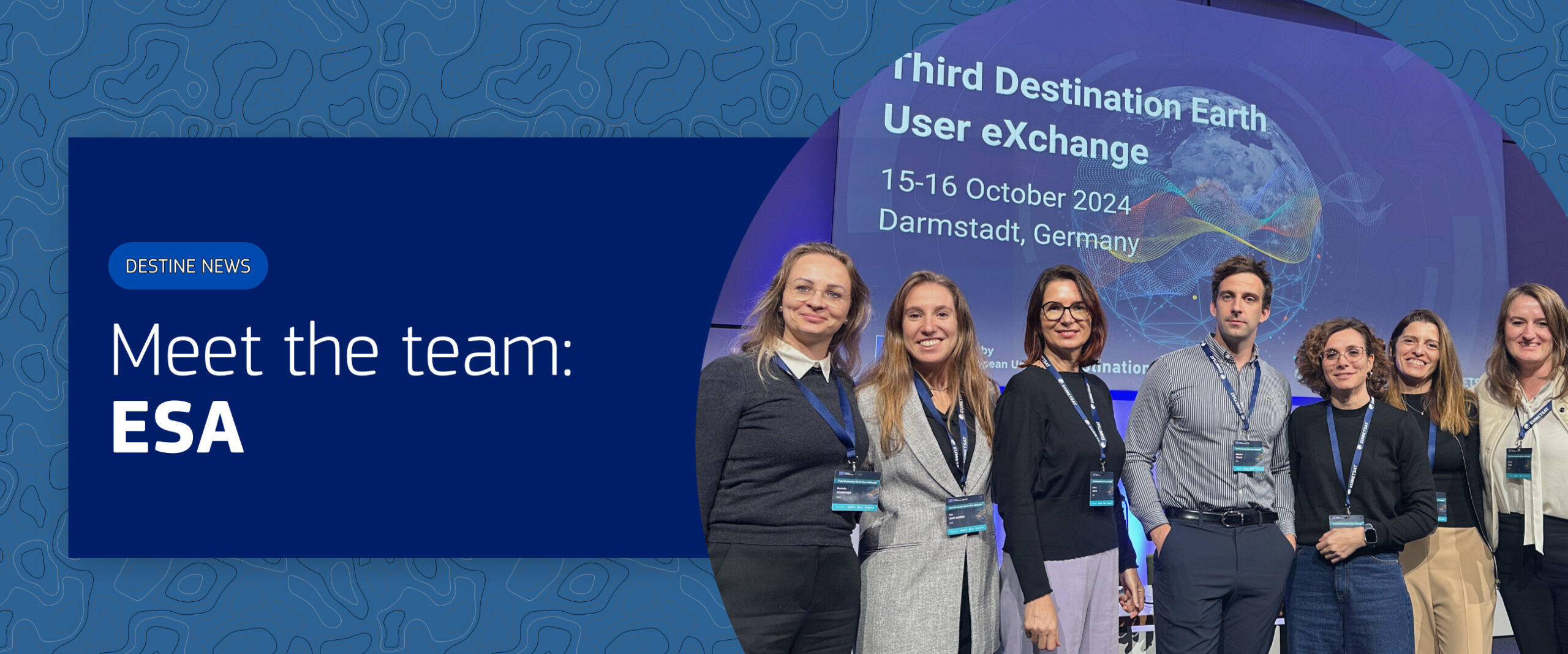
Part of ESA’s DestinE team at the third User eXchange. From left to right: Rochelle Schneider, Inés Sanz Morère, Kathrin Hintze, Sébastien Tétaud, Barbara Borgia, Claudia Vitolo and Franka Kunz
Kunz also oversees the DestinE co-design contract Within this contract, partners are building a comprehensive toolkit that will help bring service providers and users together to create services for the DestinE PlatformSelf-standing DestinE system component, interfacing with the More.
“We want to bridge the gap between those seeking to provide a service on DestinE and users,” Kunz explains. “The co-design toolkit will teach providers how to work with users from the outset to ensure that the services they create address users’ needs.”
Connecting DestinE to Europe’s digital ecosystem
Finally, another important aspect of the DestinE PlatformSelf-standing DestinE system component, interfacing with the More involves integrating it into the wider European digital landscape. Barbara Borgia is working to achieve this. After leading software development and integration teams at Serco, Borgia has been working on DestinE since the platform’s earliest days. Today, she serves as ESA’s DestinE Integration Manager and ensures DestinE connects with Europe’s digital initiatives.
She is aligning DestinE with the Common European Data Spaces, which are shared, trustworthy ‘data zones’ where citizens, companies and public organisations in the EU can safely share and use data for specific purposes. Her goal is to ensure that DestinE interacts with other European data services, rather than remaining isolated. This will encourage policymakers to adopt DestinE in their work.
Barbara Borgia and Luca Girardo pictured in their office at ESA’s premises in Frascati, Italy
“My general hope is that politicians will base their decisions on climate data,” she says. “I would really like to make a difference and see policy makers considering climate data when they make policy.”
If you would like to find out more about the DestinE PlatformSelf-standing DestinE system component, interfacing with the More, register today. Explore a growing catalogue of services offering access to Digital Twin data and powerful processing capabilities. By signing up, experimenting with the platform, and providing your feedback, you will play a part in shaping DestinE to meet the needs of its user community.