Meet the team: EUMETSAT
EUMETSATEuropean Organisation for the Exploitation of Meteorological is one of the institutions tasked by the European Commission to implement Destination Earth (DestinE). EUMETSAT’s teams are experienced in developing and managing operational data and cloud services that provide access to weather and climate-related data and information. Given this expertise, they are working on a key part of DestinE: the Data Lake.
The Data Lake implementation is overseen by Lothar Wolf, EUMETSAT’s Programme Manager for DestinE. Under his leadership, the team is developing and managing the Data Lake, which stores data produced by DestinE’s Digital Twins and provides federated access to information from ECMWFEuropean Centre for Medium-Range Weather Forecasts More, ESAEuropean Space Agency, EUMETSATEuropean Organisation for the Exploitation of Meteorological and others.
Meet some of the people who are making it all happen:
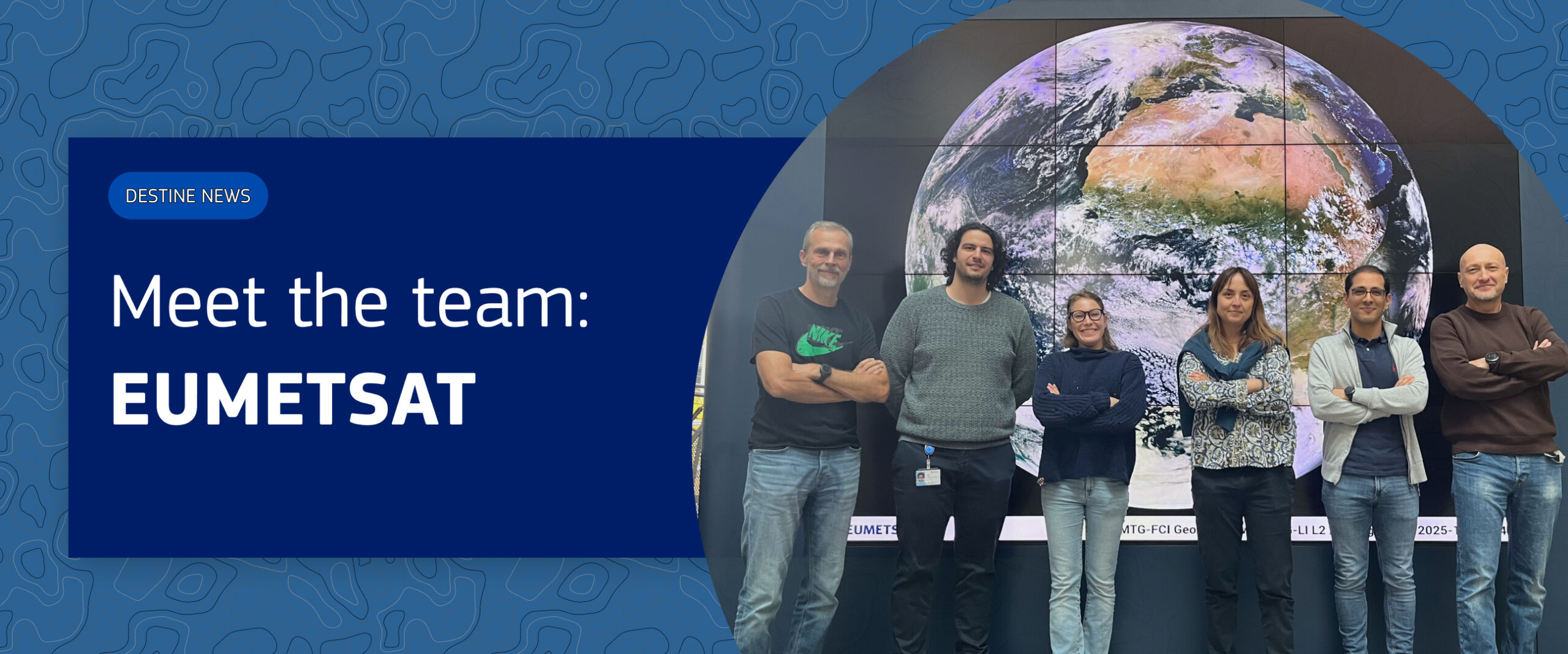
From left to right: Michael Schick, Oriol Hinojo, Danaële Puechmaille, Miruna Stoicescu, Sina Montazeri and Borys Saulyak
Michael Schick is the Data Lake System Manager at EUMETSATEuropean Organisation for the Exploitation of Meteorological. Schick is responsible for coordinating and ensuring that the technical aspects of the Data Lake are delivered in line with the contribution agreement with the European Commission. This includes overseeing technical coordination to guarantee the smooth operation of services, infrastructure, environments, and other DestinE integrations, thereby enabling reliable development, testing and deployment for all stakeholders.
He also helps define the overall architecture and direction of the Data Lake. This includes its capabilities, integration with High-Performance Computing (HPC) environments, and accessibility for users. He coordinates between institutions and ensures the Data Lake is usable, useful and future-proof.
“Our primary focus is on delivering reliable operational Data Lake services to the EC and DestinE users. This includes working hard on user uptake. We want to make sure the system remains relevant to users for a long time,” he says.
Building the Data Lake, brick by brick
Handling large volumes of data efficiently is key to DestinE, but it can be complex. Borys Saulyak, Infrastructure Manager for the Data Lake, knows first-hand how challenging (yet fun) this can be.
He oversees all aspects of cloud-based services and the physical hardware infrastructure that underpins the Data Lake. This means Saulyak coordinates with various partners and contractors to install, connect, and configure hardware across multiple European sites including Poland, Germany, Finland, Italy and Spain.
Saulyak works extensively with supercomputers. For him, the job begins with the nuts and bolts of the technology: weaving through rows of servers, racks, and cables, making sure power and network connections are flawless. Each site brings its own quirks and challenges to solve.
“This is possibly one of the largest infrastructures EUMETSATEuropean Organisation for the Exploitation of Meteorological has ever dealt with. We’re talking about hundreds of servers and hundreds of petabytes of online storage. Every part of it is designed to bring DestinE to life,” he says.
Beyond the hardware, Saulyak is also shaping the way people use the Data Lake. He oversees self-service platforms where scientists can create virtual machines, run their software, and process massive datasets – all without waiting for EUMETSAT’s direct intervention.
Future-proofing DestinE: meet the AI team
AI holds huge promise in the tech world, but when paired with the Data Lake, its potential really comes to life. Miruna Stoicescu is shaping AI activities within DestinE’s Data Lake. She oversees EUMETSAT’s AI team, coordinating the work of two engineers, Sina Montazeri and Oriol Hinojo.
One of the key focuses of the team is on AI demonstrators: contracts that explore how AI can combine DestinE’s Digital Twin outputs with EUMETSAT’s satellite data in ways that benefit users. And to ensure her team is able to optimise the response to users, they are working with ‘simulated users’.
“We have an entity involved that acts as an end user: so you have contractors doing the development, but also someone pretending to be an end user,” she explains. “They follow the whole development and make sure that the outputs match their needs.”
DestinE moves fast and challenges engineers to develop ideas and implement them quickly, and Stoicescu thrives in this environment.
“In the space sector, developments often take years. With DestinE, it’s different – it’s dynamic, fast-moving, and we can turn ideas into reality much more quickly.”
Sina Montazeri works closely with Stoicescu as a Cloud AI/ML Engineer. He helps users perform AI and machine learning tasks using the Data Lake and supports them in turning these algorithms into operational tools by leveraging Machine LearningField of statistical research focused on training computatio More Operations (MLOps) best practices. A key part of his role is developing and procuring tools, notably DEFAIR (Destination Earth Framework for AI-ready data). DEFAIR is an upcoming framework that will help users quickly convert complex, multi-format datasets into AI-ready formats. This will reduce user effort in data preparation.
“The raw data available to users is difficult to analyse, as it often comes from heterogeneous sources and in varying formats. DEFAIR will make it possible to convert this raw data into an analysis-ready form that can be easily ingested into machine learning frameworks,” Montazeri explains.
Oriol Hinojo, a Junior Cloud Data Engineer, works closely with Stoicescu and Montazeri. He supports users in performing AI tasks on DestinE and helps them make the most of the available GPU infrastructure. He also contributes to creating pipelines that automate the AI lifecycle.
Why is this important? Users need a full AI workflow on DestinE: from raw data to feature engineering, training, inference and monitoring. Automating this pipeline ensures efficiency, repeatability, and ease of use, allowing users to iterate quickly.
Users are key
Danaële Puechmaille is a technical coordinator of DestinE and other EC initiatives within EUMETSATEuropean Organisation for the Exploitation of Meteorological. A key part of Puechmaille’s role is understanding the needs of the Data Lake users – who are mainly institutions, researchers, and small to medium-sized enterprises with specific projects – and ensuring technical alignment of services.
She is also actively involved in user engagement and training. For example, in June 2025, she coordinated a training session for researchers at the Joint Research Centre (JRC) in Ispra, Italy. Her team introduced attendees to the DestinE DataEarth-system monitoring and prediction system output as prov More Lake services, which participants explored in hands-on exercises. Scientists also presented ongoing and possible future activities linked to DestinE that could be useful in their own work at the JRC.
Beyond training, Puechmaille carefully reports progress and results to the European Commission and partners, keeping everyone updated on where EUMETSATEuropean Organisation for the Exploitation of Meteorological stands with the Data Lake. She also manages different contracts, including those on the AI demonstrators Stoicescu and her team are working on.
“One of the challenges with DestinE is also one of its greatest strengths – we all have to work together. Coordinating closely with our partners is essential for making the initiative a success,” she says.
If you would like to find out more about the DestinE DataEarth-system monitoring and prediction system output as prov More Lake or the services mentioned in this article, visit the Data Lake website. And to meet the teams from ECMWFEuropean Centre for Medium-Range Weather Forecasts More and ESAEuropean Space Agency, subscribe to our community newsletter. We will be sharing their stories soon!